> ## Documentation Index
> Fetch the complete documentation index at: https://agent-observability-docs.splunk.com/llms.txt
> Use this file to discover all available pages before exploring further.
# Datasets overview
> Manage test sets and training sets across all your projects.
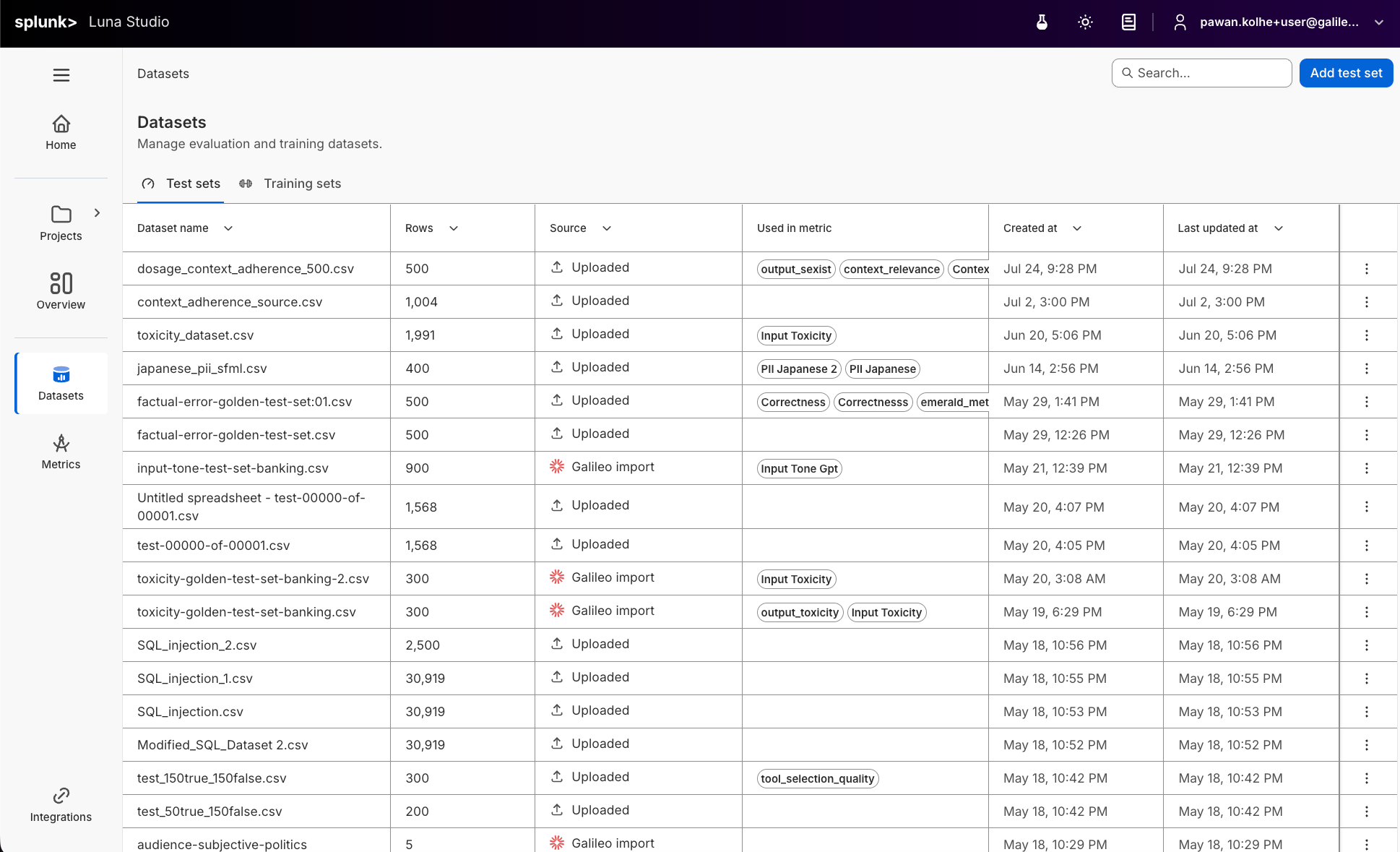
The **Datasets** page (sidebar → **Datasets**) is where you manage every dataset in your organization. Datasets are organization-wide — once added, they are available across every project for any training run.
 ## Test sets vs. training sets
Luna Studio splits datasets into two flavors, accessible via tabs on the page:
Small, human-labelled datasets used to evaluate fine-tuned evaluators. Required for every run.
Larger datasets used to fine-tune the base model. Often generated from a test set.
## How datasets relate to runs
Each [training run](/luna-studio/ui/runs/lifecycle) consumes exactly one test set and one training set. The same dataset can be reused across many runs.
```mermaid theme={null}
flowchart LR
TestSet1["Test set: context-adherence-test"] --> Run1["Run 1: context-adherence-run-1"]
TrainSet1["Training set: context-adherence-train-v1"] --> Run1
TestSet1 --> Run2["Run 2: context-adherence-run-2"]
TrainSet2["Training set: context-adherence-train-v2"] --> Run2
```
The **Used in evaluator** column on the datasets table shows you which evaluators' fine-tuning depends on a dataset — useful before deleting one.
## Source types
| Source | What it means |
| -------------------------- | ----------------------------------------------------------------------------------------------------- |
| Upload | You uploaded a `.csv` or `.jsonl` file from your machine. |
| URL | Luna Studio fetched the dataset from a public or pre-signed HTTP(S) URL. |
| Splunk Agent Observability | Luna Studio pulled the dataset from a project in your connected Splunk Agent Observability workspace. |
The source picker accepts JSONL during ingestion, but the current run-validation and data-generation paths read CSV. Convert JSONL to CSV before using the dataset in a run.
For training sets specifically, an additional source applies:
* **Generated** — produced by the [Generate from test set](/luna-studio/ui/runs/new-run/step-3-training-set#generate-from-test-set) flow inside the run creation flow.
## Where to go next
What test sets are, schema rules, and best practices.
What training sets are and how to create or reuse them.
Reference for the three dataset sources (Upload, URL, Splunk Agent Observability).
What Luna Studio checks when a dataset is used in a run.
## Test sets vs. training sets
Luna Studio splits datasets into two flavors, accessible via tabs on the page:
Small, human-labelled datasets used to evaluate fine-tuned evaluators. Required for every run.
Larger datasets used to fine-tune the base model. Often generated from a test set.
## How datasets relate to runs
Each [training run](/luna-studio/ui/runs/lifecycle) consumes exactly one test set and one training set. The same dataset can be reused across many runs.
```mermaid theme={null}
flowchart LR
TestSet1["Test set: context-adherence-test"] --> Run1["Run 1: context-adherence-run-1"]
TrainSet1["Training set: context-adherence-train-v1"] --> Run1
TestSet1 --> Run2["Run 2: context-adherence-run-2"]
TrainSet2["Training set: context-adherence-train-v2"] --> Run2
```
The **Used in evaluator** column on the datasets table shows you which evaluators' fine-tuning depends on a dataset — useful before deleting one.
## Source types
| Source | What it means |
| -------------------------- | ----------------------------------------------------------------------------------------------------- |
| Upload | You uploaded a `.csv` or `.jsonl` file from your machine. |
| URL | Luna Studio fetched the dataset from a public or pre-signed HTTP(S) URL. |
| Splunk Agent Observability | Luna Studio pulled the dataset from a project in your connected Splunk Agent Observability workspace. |
The source picker accepts JSONL during ingestion, but the current run-validation and data-generation paths read CSV. Convert JSONL to CSV before using the dataset in a run.
For training sets specifically, an additional source applies:
* **Generated** — produced by the [Generate from test set](/luna-studio/ui/runs/new-run/step-3-training-set#generate-from-test-set) flow inside the run creation flow.
## Where to go next
What test sets are, schema rules, and best practices.
What training sets are and how to create or reuse them.
Reference for the three dataset sources (Upload, URL, Splunk Agent Observability).
What Luna Studio checks when a dataset is used in a run.