

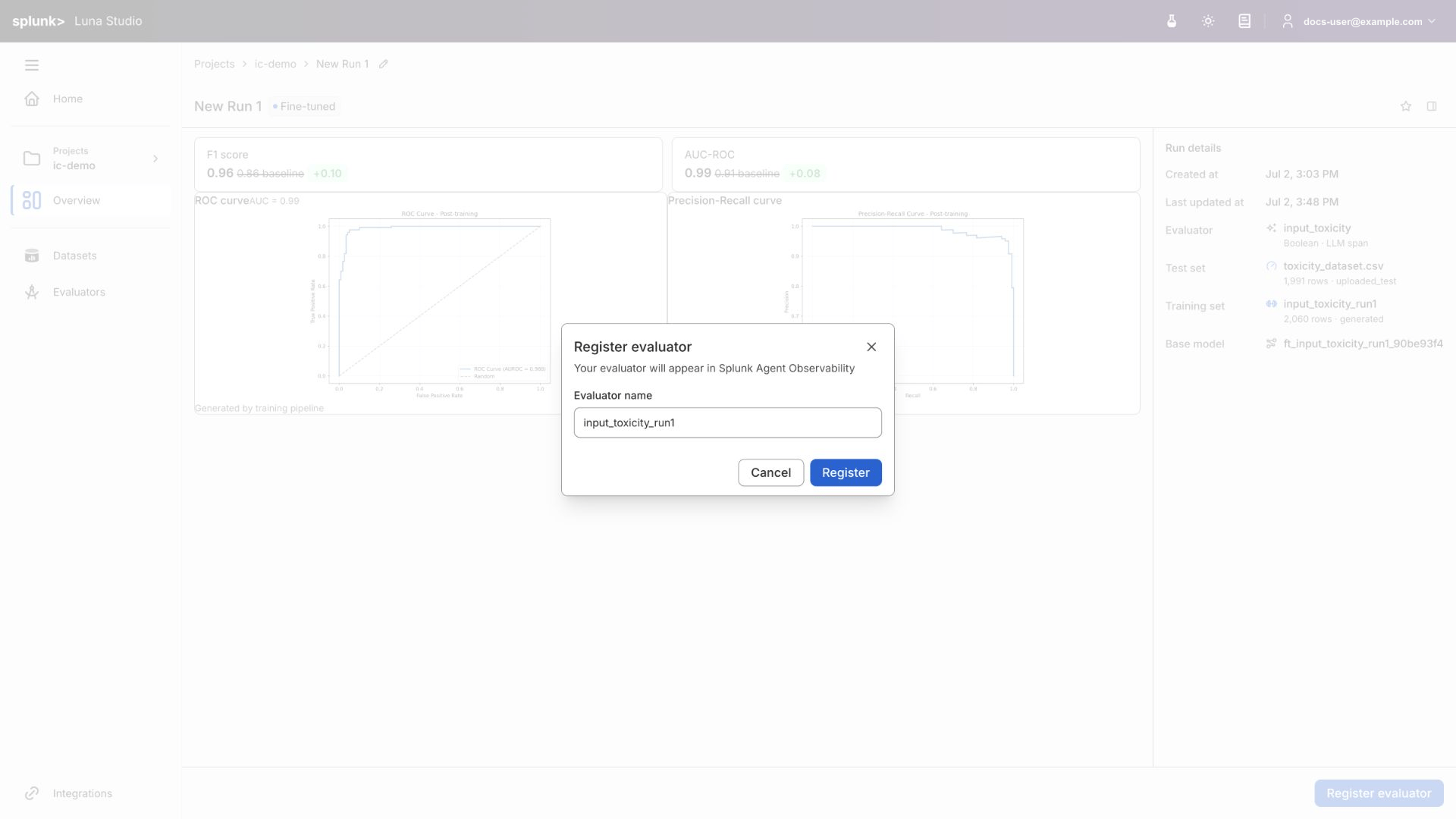
Register evaluator modal opened from the run details page
Prerequisites
- The run must be in the Fine-tuned status. See Run lifecycle.
- The Luna Studio deployment must have an active Splunk Agent Observability API connection.
- The evaluator must have a supported registration runtime contract.
Registration eligibility
Full-trace, full-session, and other evaluator contracts without a supported Splunk Agent Observability runtime are blocked from registration. Context relevance is a separate, registration-only exception keyed to the built-in scorer’s identity. Its prompt depends on retrieved documents, but generic fine-tuned scorer registration would remove that dependency and change what the evaluator evaluates. Context relevance can therefore be trained and evaluated in Luna Studio, but not registered today. This restriction does not make the RAG evaluator shape generally ineligible for registration.Where you can register from
The Register evaluator action appears in three places:- Run details page — primary footer button on Fine-tuned runs.
- Training runs table — an action link on each Fine-tuned row. See Training runs home.
- Evaluators page — an action link on each Fine-tuned evaluator. See Evaluators overview.
Steps
1
Click Register evaluator
From the run details footer, the runs table row, or the evaluators page row.
2
Enter an evaluator name
Use a name that’s clear in the Splunk Agent Observability evaluators store, where it’ll sit alongside built-in evaluators. Examples:
support-tone-strict, pii-detector-en.3
Click Register
The modal closes. After registration succeeds, the run’s status flips to Registered and the Register evaluator affordance disappears for that run.
If registration is blocked
On the run details page, read the blocker shown with the disabled footer action. From the Training runs table or Evaluators page, read the error that remains in the modal after an unsuccessful submission. Common cases are:- No Splunk Agent Observability connection — ask your deployment operator to configure the Splunk Agent Observability API URL and key.
- Unsupported evaluator contract — the fine-tuned artifact remains available in Luna Studio, but that evaluator cannot be published to the Splunk Agent Observability evaluators store.
Naming guidance
- Use lowercase with hyphens:
customer-tone-classifier, notCustomer Tone Classifier. - Include the language or domain if relevant:
pii-detector-en,legal-toxicity. - Add version suffixes (
-v1,-v2) if you are registering multiple variants.
Where to go next
Agent Control
Use registered evaluators in Agent Control workflows.
Initialize Agent Control
Configure the Splunk Agent Observability Logger and Agent Control SDK.
Luna-2
Understand how Luna-based evaluators power evaluation and protection.